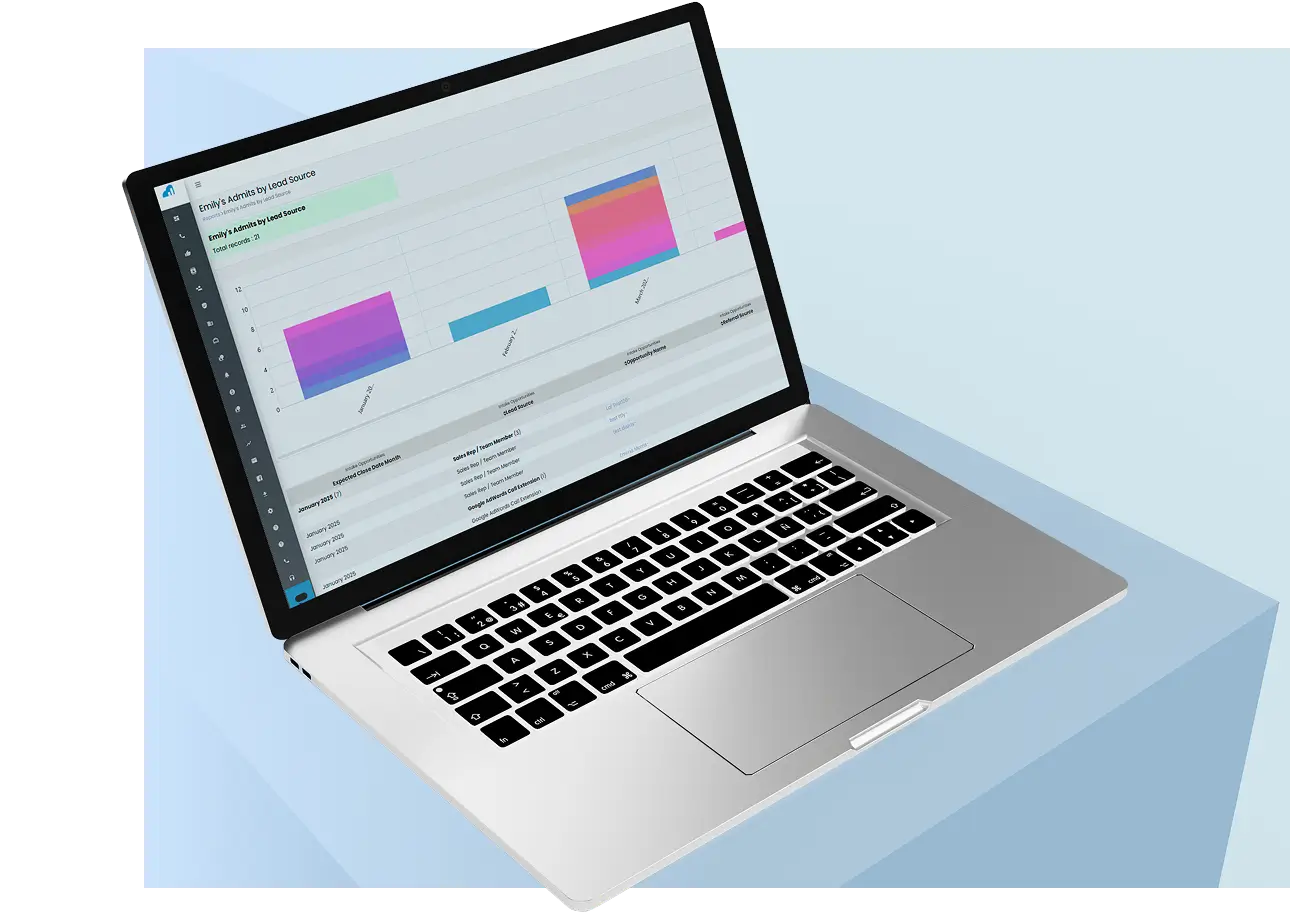

The best behavioral health CRM does more than store contact information and track leads.
Treatment organizations have unique workflows involving admissions, insurance verification, referrals, marketing, billing, and alumni engagement.
The right CRM should connect those functions while giving your team better insight into what happens from the first inquiry through admission and beyond.
Here’s what to look for when comparing behavioral health CRM software.
What Is a Behavioral Health CRM?
A behavioral health customer relationship management (CRM) platform helps organizations manage the operational relationships and activities surrounding treatment.
While an electronic medical record (EMR) primarily manages clinical information, a CRM focuses on areas such as inquiries, admissions, referrals, communications, business development, and marketing.
The two systems shouldn’t compete with each other. A strong behavioral health CRM should integrate with your EMR so information can move between systems without unnecessary manual entry.
The Dazos CRM, for example, offers pre-built integrations with leading behavioral health EMRs.
What Should the Best Behavioral Health CRM Software Include?
Generic CRM features aren’t enough to determine whether a platform will work well in a treatment environment.
When comparing your options for behavioral health CRMs, look for these capabilities:
1. Behavioral Health-Specific Workflows
Your team shouldn’t have to turn a traditional sales pipeline into a behavioral health admissions process.
Look for software built around the terminology, workflows, and operational needs your staff already understands. Purpose-built workflows can also reduce the amount of customization required before your team can begin using the platform.
2. Admissions Management
A CRM should give your admissions team visibility into every inquiry and referral.
That includes tracking where prospects are in the admissions process, assigning follow-up tasks, recording communications, and identifying inquiries that have stalled.
The goal is simple: make it harder for someone seeking treatment to fall through the cracks.
3. Insurance Verification
Insurance verification can create significant delays during admissions when staff must call payers, enter information into separate systems, and manually create verification documents.
Integrated verification can reduce those steps. Dazos iVerify, for example, checks eligibility and benefits and connects the resulting VOB directly to the patient record inside the CRM.
4. EMR Integration
Your CRM and EMR serve different purposes, but your team shouldn’t have to repeatedly enter the same information into both.
Look for integrations that allow relevant information to move between your operational and clinical systems while preserving each platform’s role.
5. Marketing Attribution
Clicks and leads only tell part of the story.
Behavioral health organizations need to know which marketing channels actually produce admissions and revenue. A strong behavioral health CRM should connect marketing sources to what happens later in the patient journey.
That allows marketing leaders to evaluate cost per admission and collected revenue rather than relying only on impressions, clicks, or form submissions.
6. Referral Relationship Management
Professional referrals remain an important growth channel for many treatment organizations.
Your CRM should help business development teams track referral sources, communication, activity, and outcomes.
Ideally, you should be able to see which relationships consistently produce admissions rather than simply how often a representative contacted someone.
7. Revenue Intelligence
Admissions aren’t the end of the financial journey.
Connecting CRM information with reimbursement data can help leadership understand the revenue associated with different admissions, payers, referral sources, and marketing efforts.
Dazos IQ also identifies underpaid and unpaid claims, providing another layer of visibility into revenue that may otherwise be missed.
8. Useful Automation and AI
AI should reduce work or make information easier to use, not exist simply because AI is popular.
Look for practical capabilities such as automated follow-up, record summaries, operational dashboards, and the ability to quickly answer questions using existing CRM data.
Dazos’ SamurAI intelligence layer includes tools that surface operational metrics, answer questions about CRM data in plain language, and summarize individual records.
9. HIPAA Compliance and Data Security
Behavioral health organizations work with sensitive information, making security and compliance essential considerations.
Ask prospective CRM providers about access controls, data protection, audit capabilities, and how the platform supports your organization’s HIPAA compliance requirements.
General CRM vs. Behavioral Health CRM: What’s the Difference?
General-purpose CRMs can offer powerful contact management, reporting, automation, and customization.
The challenge is making those tools fit behavioral healthcare.
A generic platform may require extensive configuration to accommodate:
- Treatment inquiries
- VOBs
- Referral relationships
- Behavioral health terminology
- EMR integrations
- Other industry-specific workflows
A purpose-built behavioral health CRM starts with those needs already in mind.
That can mean less time adapting software around your organization and more time using it to improve admissions, operations, and growth.
Why Dazos Is a Leading Behavioral Health CRM
Dazos was designed specifically for behavioral health organizations rather than retrofitted from a traditional sales CRM.
The platform connects the patient journey from inquiry through alumni while bringing admissions, referrals, communications, marketing, and revenue data together. Behavioral health workflows and EMR integrations are built into the CRM, while organizations can configure fields, dashboards, automations, and workflows without relying on developers for every change.
Additional Dazos solutions expand those capabilities through iVerify for insurance verification, IQ for revenue intelligence, iCampaign for automated engagement, and SamurAI for AI-powered operational intelligence.
Instead of adding more disconnected technology, behavioral health organizations can connect more of their operational data in one ecosystem.
Questions to Ask Before Choosing a Behavioral Health CRM
Before committing to a platform, ask:
- Was it built specifically for behavioral health?
- Does it integrate with your existing EMR?
- Can you track the full journey from inquiry through admission and collected revenue?
- Can your team complete insurance verification within the workflow?
- Can marketing sources be connected to admissions and collected revenue?
- Can you measure referral-source performance?
- What processes can you automate?
- How much customization requires outside technical support?
- Can the platform support multiple facilities as you grow?
The best behavioral health CRM is ultimately the one that fits the way your organization actually operates.
See Dazos Behavioral Health CRM in Action
Dazos brings admissions, marketing, referral management, insurance verification, revenue intelligence, and AI-powered insights together in a platform designed specifically for behavioral health.
Schedule a demo to see how Dazos can help your team streamline operations, increase admissions, and build more predictable revenue growth.
Sources
- U.S. Department of Health & Human Services. Covered Entities and Business Associates. Retrieved from: https://www.hhs.gov/hipaa/for-professionals/covered-entities/index.html. Accessed on November 15, 2026.
- U.S. Department of Health & Human Services. Business Associates. Retrieved from: https://www.hhs.gov/hipaa/for-professionals/privacy/guidance/business-associates/index.html. Accessed on November 15, 2026.