
You didn’t get into behavioral health to manage spreadsheets, chase insurance claims, or wonder which marketing channel actually drove that last admission.
But here’s the reality for most addiction treatment and mental health operators: the clinical side of the house is strong. The business operations side? That’s where revenue leaks, opportunities are missed, and growth stalls.
More than 1 in 5 American adults— 61.5 million people—are living with a mental illness right now. Of the 52 million who need substance use treatment, only 1 in 5 ever receives it. (SAMHSA, 2025.) The U.S. behavioral health market is projected to reach $132 billion by 2032. (Fortune Business Insights.) The demand is there. The opportunity is real. And yet, facility after facility hits the same invisible ceiling—one that has nothing to do with the quality of care they deliver.
The ceiling is operational.
After working with more than 1,500 behavioral health facilities—from single-location treatment centers to PE-backed multi-state platforms—we’ve identified five operational gaps that consistently separate facilities that scale from those that stagnate. None of them are clinical. All of them are fixable.
Gap #1: The Admissions Funnel Leak
Where Patients — and Revenue — Fall Through the Cracks
Here’s a scary thought: a lot of behavioral health crisis calls arrive outside standard business hours.Also – industry data shows 75% of leads never respond after the first contact attempt.
For most facilities, that combination means a significant portion of marketing spend generates zero return—not because the leads weren’t good, but because the operational infrastructure to capture and follow up on them isn’t there.
Every missed after-hours call represents an average of $10,000–$50,000 in lost per-episode revenue. Every cold lead that goes unworked is $100–$500 in acquisition cost with no return. Multiply that across a month, and you’re not looking at a rounding error—you’re looking at a six-figure annual leak.
What this gap looks like in practice:
- Lead tracking done in spreadsheets or sticky notes, with no standardized follow-up sequence
- After-hours calls going to voicemail—with no system to flag, route, or respond to them
- No visibility into which referral sources are producing qualified leads vs. wasting acquisition spend
The facilities closing this gap aren’t necessarily spending more on marketing. They’re getting smarter about how they capture and convert the demand they already have using automated lead tracking, AI agents, mobile-enabled admissions tools, and structured follow-up sequences that don’t depend on a single coordinator remembering to make a call.
Gap #2: The Revenue Visibility Problem
You Can’t Recover What You Can’t See
Most behavioral health billing teams are working hard. The problem isn’t effort, it’s visibility.
Without a clear window into payer performance, claim status, and reimbursement trends across your patient population, it’s nearly impossible to know which claims are underpaid, which are stuck in limbo, and which represent revenue you’ve already earned but haven’t collected.
The average behavioral health facility leaves 10–15% of revenue uncollected from billing gaps alone. That’s not a billing staff problem. That’s a data visibility problem.
Atlas Healthcare Group experienced this directly. Their billing team was working hard—but without transparency into payer performance and claim-level data, they were chasing what they knew about and missing what they didn’t. After gaining that visibility, they saw a 3.5–4% improvement in collection rate. On a multi-million dollar revenue base, that’s not a rounding error.
What this gap looks like in practice:
- Billing teams relying on payer remittances they receive rather than actively tracking claims they’ve submitted
- No system to flag underpaid claims before they age out of appeal windows
- CFOs reporting on revenue they think they earned rather than revenue they’ve actually collected
The fix isn’t more billing staff. It’s gaining transparency into what’s already there—and building the systems to act on it before it becomes unrecoverable.
Gap #3: Fragmented Systems and the Manual Workflow Tax
When Your Teams Can’t See Each Other’s Work
Many behavioral health facilities use three or more disconnected tools for admissions, billing, and marketing. The result is what we call the “manual workflow tax”—the invisible hours your team spends each week copying data between systems, pulling reports into spreadsheets, and resolving discrepancies between tools that have no idea the others exist.
The cost shows up in three ways: wasted staff time, decision lag, and errors that compound over time.
Rockland Recovery, a substance use disorder facility in Massachusetts, knows this story well. When they first implemented Dazos, their admissions director was tracking leads on paper and spreadsheets with zero visibility into referral source performance, cost per admission, or marketing ROI. Compliance reports that had been taking 10 hours now run in 15 minutes.
What this gap looks like in practice:
- Admissions, billing, and marketing teams working from different data sets with no shared source of truth
- Patient journey data siloed inside the EMR with no connection to the admissions pipeline
- Leadership running the business on reports built the day before the meeting, already out of date
The behavioral health operators who scale efficiently have one thing in common: a unified operational view. Not because they bought more tools—because they consolidated the ones they had.
Gap #4: The Marketing Attribution Blind Spot
Spending Money Without Knowing What Works
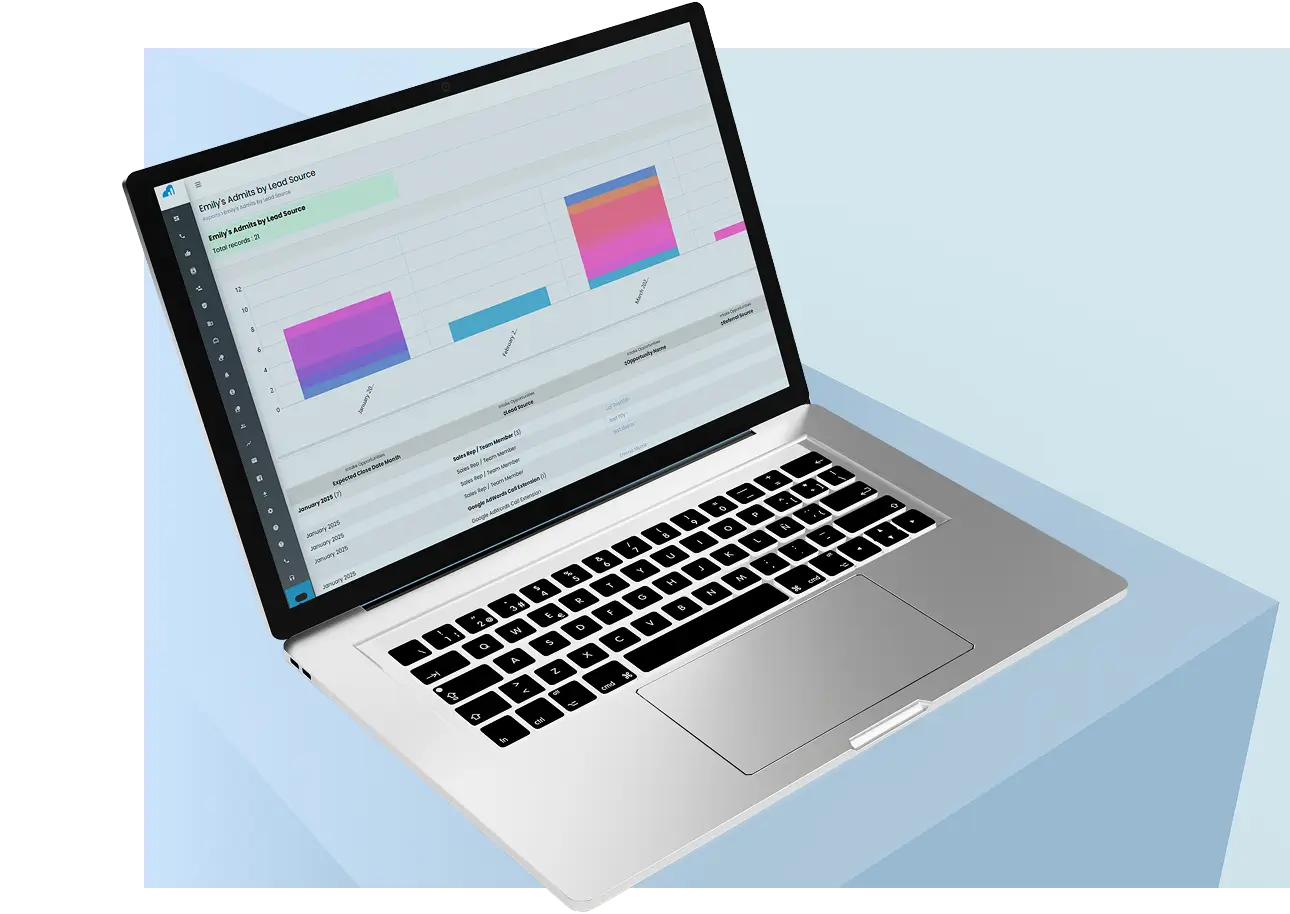
Many behavioral health facilities can’t connect their marketing spend to actual admitted patients, or revenue tied to those patients. They know what they’re spending. They don’t know what it’s producing.
This isn’t a marketing problem. It’s an attribution infrastructure problem. When admissions and marketing data lives in one system and revenue data lives in another, there’s no mechanism to connect a Facebook lead to an admitted patient to a collected claim. You end up making budget decisions based on assumptions—which channels feel productive, which reps seem busy—rather than data.
S2L Recovery, a faith-based treatment organization in rural Tennessee, ran their entire inbound operation on a Google Sheet before getting operational visibility. They had no way to identify cost per lead or whether their marketing was reaching the right people. After building proper attribution infrastructure, they were able to tie every inquiry to a source, measure conversion rates from marketing to admissions, and make data-backed decisions about where to spend—decisions that ultimately funded the expansion to a new 26-bed campus.
What this gap looks like in practice:
- Marketing budgets allocated based on gut feel rather than channel-level performance data
- Referral sources tracked in a contact list rather than connected to actual admission and revenue outcomes
- No ability to calculate cost per admission by channel, making growth planning a guessing game
Operators who solve this gap don’t necessarily spend more on marketing. They spend smarter—cutting underperforming channels, doubling down on what works, and building referral relationships where the data shows real yield.
Gap #5: Alumni Engagement and the Continuity-of-Care Opportunity
Your Most Likely Next Admission Is Someone Who Knows Someone You Helped (or your Alumni themselves)
After discharge, most behavioral health facilities lose touch with their alumni. It’s understandable—there’s always another admission to focus on, another insurance claim to chase. But the clinical reality of behavioral health is that recovery is rarely linear, and continuity of care matters enormously both for patient outcomes and for census stability.
Facilities that build systematic alumni engagement programs don’t just serve their patients better—they grow more predictably. Alumni who feel connected to a facility are more likely to return for step-down care, recommend the facility to peers in need, and re-engage during relapse rather than seeking care elsewhere.
PUR Health & Wellness in Vero Beach, Florida turned this gap into a measurable growth driver. After implementing systematic alumni engagement—automated outreach, outcome tracking, and readmission alerts—they saw a 25% increase in former clients returning for additional care when they needed it. Not from new marketing. From a relationship they were already positioned to have.
What this gap looks like in practice:
- No systematic post-discharge communication beyond a discharge summary and a referral to an outpatient provider
- Alumni contact information scattered across the EMR with no engagement tracking
- No readmission workflow—facilities learn about relapses from family members calling in crisis, not from proactive monitoring
The facilities that get this right treat alumni engagement as a priority, as well as a referral network. Because in behavioral health, the best new admission is often someone in your sphere of influence.
The Facilities That Scale Have Already Closed These Gaps
Between rising labor costs, staffing shortages, and payer scrutiny that keeps intensifying, the behavioral health organizations growing sustainably right now aren’t just excellent at care delivery. They’ve built operational systems that match their clinical ambition.
The five gaps above—admissions leakage, revenue invisibility, fragmented systems, marketing attribution blind spots, and disconnected alumni engagement—are not unique to any one facility type or size. We see them in single-location programs and multi-state PE-backed platforms alike. What differs is whether leadership has the systems in place to identify and close them.
The good news: none of these gaps require more headcount to fix. They require better infrastructure—the kind that gives your existing team the visibility, automation, and integrated data they need to make decisions quickly and act on them consistently.
That’s the operational foundation that scaling behavioral health facilities are built on. And it’s more accessible than most operators realize.
Want to see how Dazos helps close these gaps?
Dazos is the market-leading behavioral health revenue growth platform trusted by over 1,500 addiction treatment and mental health facilities. We unify admissions, billing intelligence, and marketing analytics in one platform—built by behavioral health operators, for behavioral health operators.
Contact us today to book a 30-minute discovery call.