
You’re on a live call with a patient’s family. The record is open. You have thirty seconds to pull up prior history, insurance status, and assessment flags. Meanwhile you’re hunting through comment logs and timestamped notes to find any of it.
That gap between the data your CRM already holds and the moment you actually need it is where admissions opportunities are won and lost.
Behavioral health organizations generate enormous amounts of operational data every day. Admissions inquiries, referral trends, response times, communications, billing activity, and reporting metrics all provide valuable signals about how efficiently an organization is functioning.
The challenge isn’t access to data, but turning that data into faster, more informed decisions.
For many behavioral health organizations, operational insights live across dashboards, spreadsheets, disconnected workflows, or reports that take time to interpret.
Teams may recognize intake slowdowns, referral shifts, or communication bottlenecks only after they’ve already affected admissions, staff workload, or revenue.
The solution most behavioral health organizations are discovering isn’t a new platform or a workflow overhaul. It’s AI built in directly into the CRM they already use — purpose-built on their actual admissions, referral, and lead data, surfacing insights automatically without requiring staff to go find them.
Why Behavioral Health Teams Struggle to Turn Data Into Action
Behavioral health operations are complex.
Admissions teams often juggle fluctuating referral volume, insurance verification timelines, multiple levels of care, communication workflows, staffing variability, and census goals at the same time.
Questions like these are common:
- Why are inquiry response times increasing?
- Which referral sources are converting into admissions most consistently?
- Where are intake delays slowing admissions momentum?
- Why are communication bottlenecks appearing during high-volume periods?
- Why does finding the answer still require navigating to a different report — or building a custom view?
The answers often exist somewhere in the data.
But identifying trends manually takes time, and in behavioral health operations, delays can cost you…
By the time teams recognize a pattern, missed opportunities may already have impacted admissions, workflow efficiency, or revenue visibility.
What AI Built Into Your Behavioral Health CRM Can Actually Do
When AI is purpose-built on your CRM data rather than added as a separate tool, it closes the gap between data and decision in three meaningful ways.
Proactive Dashboards That Surface Insights Automatically
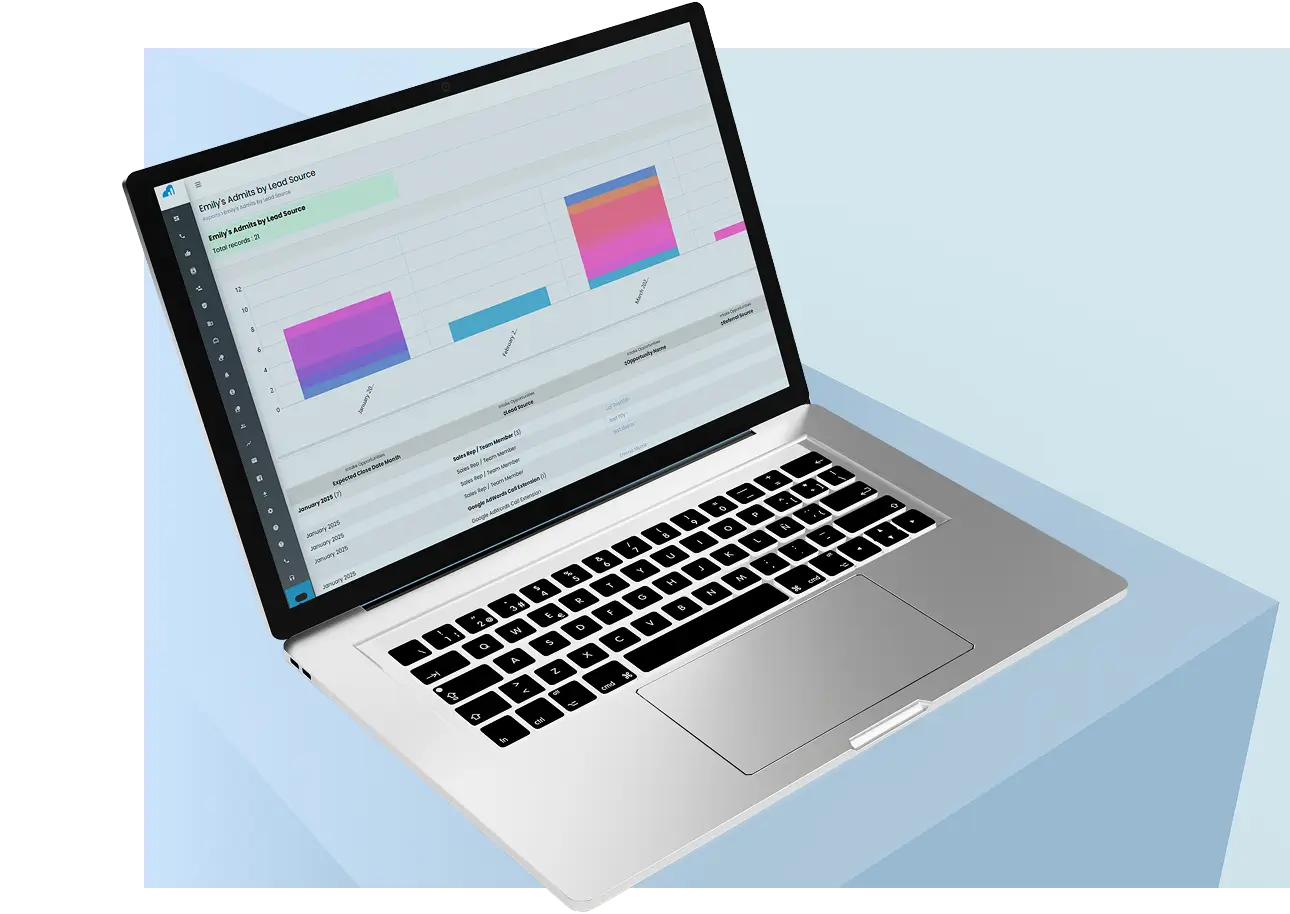
Most behavioral health teams spend time navigating to insights. The right AI flips that: instead of building filters or refreshing custom views, AI-powered dashboards surface the metrics that matter proactively without you having to go find them.
For behavioral health organizations, that means seeing missed call volume by time period, marketing spend efficiency by channel, census pacing, admissions funnel performance, and expected revenue all in one view, updated automatically from the CRM data you already have.
The shift from reactive reporting to proactive visibility means leadership always has clarity. Not after chasing it.
Conversational Access to Your CRM Data — Just Ask
What if getting a specific answer from your CRM were as simple as asking for it in plain language?
AI tools built directly into platforms like Dazos allow admissions directors, BD leaders, and operators to ask plain-language questions about their live data — “What were my top referral sources this quarter?” or “Break down admissions by lead source this month” — and get instant answers. Ask a follow-up. Drill deeper. No navigation. No custom filters. No waiting for a report.
For behavioral health teams managing high inquiry volume, that speed translates directly into faster decisions at every level of the organization.
AI Summaries That Cut Through Record Noise on Live Calls
When a patient or family member calls, your admissions team needs context immediately. Prior history. Insurance status. Assessment flags. Open follow-up items.
AI working directly inside your CRM can distill all of that (the comment threads, activity logs, verification of benefits status, assessment notes) the moment a record opens. No hunting through months of notes. No rereading logs mid-call. Just the sharp context your team needs to act, right now.
That kind of readiness is what separates prepared admissions conversations from reactive ones. It’s also what makes the difference on the calls that turn into admissions.
How AI-Powered Systems Help Reveal Operational Bottlenecks Faster
AI-powered systems can help behavioral health teams move from reactive problem-solving to faster operational awareness.
Instead of requiring staff to manually connect patterns across reports or workflows, AI-powered insights surface operational signals in real time, inside the system they’re already working in.
For behavioral health organizations using connected systems like the Dazos CRM, AI-powered workflows can help bring admissions, referrals, communications, billing visibility, and reporting into one clearer operational picture. This makes it easier to identify inefficiencies before they impact growth.
For example, with Dazos, behavioral health organizations can identify:
- Slower inquiry response times affecting admissions conversion
- Referral trends influencing census or lead quality
- Communication delays impacting intake efficiency
- Workflow bottlenecks contributing to slower admissions timelines
- Reporting trends tied to operational performance or revenue visibility
The goal isn’t replacing operational teams. It’s making them sharper – with better context, faster answers, and less time spent navigating to information that should already be in front of them..
Turning Connected Data Into Faster Behavioral Health Decisions
Behavioral health organizations already collect the data needed to improve performance.
The challenge is visibility.
For behavioral health teams using connected systems like Dazos, admissions, referrals, communications, billing visibility, and reporting workflows become easier to view in context — creating a clearer picture of how operational performance affects growth.
Instead of reacting after conversion slows or intake delays increase, organizations can make faster, more informed decisions around:
- Inquiry follow-up timing
- Referral source performance
- Admissions workflow efficiency
- Communication bottlenecks
- Revenue visibility and reporting trends
When AI is built directly into those workflows, teams get those insights where the work is already happening.
How AI-Powered Insights Support Revenue Visibility in Behavioral Health
In behavioral health, operational inefficiencies don’t stay isolated for long. A slower intake workflow delays admissions. Missed follow-ups reduce conversion. Referral bottlenecks impact census consistency. Over time, those disruptions affect revenue visibility across the entire organization.
That’s why many behavioral health organizations are shifting toward connected systems that make operational data easier to act on.
When admissions workflows, referral tracking, communications, billing visibility, and reporting exist in one connected environment, behavioral health teams can better understand how day-to-day operational decisions influence financial performance.
For teams using platforms like Dazos CRM and Dazos IQ, AI-powered insights may help identify patterns tied to:
- Slower inquiry-to-admission timelines affecting conversion
- Referral sources generating lower admissions value over time
- Workflow inefficiencies impacting operational performance
- Delays that contribute to reimbursement or revenue visibility challenges
- Reporting trends that help leaders make faster operational decisions
Rather than waiting until census or revenue performance shifts significantly, behavioral health organizations gain clearer visibility into where operational friction may be occurring — and where to focus attention first.
Getting More Value From Existing Behavioral Health Workflows
For behavioral health organizations already using connected operational systems, AI-powered insights are often most valuable when applied to workflows teams already rely on every day.
That includes:
- Proactive admissions dashboards — census pacing, funnel visibility, and missed call tracking surfaced automatically, without navigating to separate reports
- On-demand CRM answers — admissions, referral, and BD performance questions answered instantly, in plain language, from your live data
- AI record summaries on live calls — every lead, opportunity, and assessment distilled the moment it opens, so your team always has context before the conversation starts
- Referral source intelligence — conversion rates, follow-up gaps, and relationship history surfaced proactively for BD teams
- Marketing and BD visibility — channel performance, campaign results, and rep activity without pulling a custom report
In many cases, the biggest opportunity lies with making better use of the operational data organizations already collect, without requiring a new platform, new training, or changes to existing workflows.
Small operational improvements, such as identifying slower follow-up windows, improving referral visibility, or reducing communication friction between admissions and billing-related workflows, can create measurable gains over time.
Smarter Behavioral Health Operations Start With Better Visibility
Behavioral health organizations don’t need more information. They need sharper, faster insight into what the operational data they already have is telling them.
As referral patterns shift, census fluctuates, and operational demands grow, behavioral health teams need AI that works inside the systems they already trust: surfacing insights automatically, answering questions instantly, and preparing teams before every conversation. That’s where AI built directly into your CRM makes a measurable difference.
By bringing admissions, referrals, communications, billing visibility, and reporting into one connected environment, Dazos helps behavioral health organizations find operational insights faster, reduce inefficiencies, and make more informed decisions across the business.
In turn, teams can strengthen admissions workflows, improve operational visibility, and gain clearer insight into the activities that support long-term growth and revenue performance.
Want to see how AI built into your Dazos CRM can sharpen admissions visibility, accelerate decision-making, and strengthen revenue performance — without adding a new platform?
Explore how Dazos helps behavioral health organizations turn operational data into smarter, faster decisions every day.
Frequently Asked Questions About AI-Powered Behavioral Health CRM Tools
AI built into behavioral health CRM platforms like Dazos surfaces admissions insights, referral performance data, and operational metrics automatically — without requiring teams to navigate reports or build custom views. It can also answer plain-language questions about CRM data instantly and summarize records the moment they’re opened, giving admissions staff the context they need before and during calls.
AI helps admissions teams by surfacing the right context before and during conversations with patients, families, or referral sources. When a record opens, AI can distill prior history, insurance verification status, assessment flags, and activity into a clear summary — so teams are prepared to act, not scrambling to catch up.
Yes. When AI is built directly onto an existing CRM like Dazos, behavioral health organizations get AI-powered insights without adopting a new platform, changing workflows, or retraining staff. The AI works inside the system teams already use.
AI-powered dashboards built for behavioral health can surface metrics including census and admissions pacing, inquiry response times, missed call volume by time period, referral source conversion rates, marketing channel performance, business development rep activity, length of stay, and revenue trends — proactively, without manual report-building.
By identifying operational friction early — slower intake timelines, referral bottlenecks, missed follow-ups — AI helps behavioral health organizations address inefficiencies before they impact admissions and revenue. Connected systems with AI give finance and operations leaders real-time visibility into the activities that influence financial performance.
A traditional CRM stores and organizes operational data. AI built on top of a CRM — like the intelligence layer within Dazos — actively surfaces that data, answers questions about it in plain language, and summarizes records in the moment they’re needed. The difference is the shift from passive data storage to active operational intelligence.
Sources
- McKinsey & Company. The Future of AI in Healthcare: Healthcare’s AI Opportunity. Retrieved from: https://www.mckinsey.com/industries/healthcare/our-insights/the-future-of-ai-in-healthcare. Accessed May 28, 2026.
- The National Council for Mental Wellbeing. Behavioral Health Workforce Resources. Retrieved from: https://www.thenationalcouncil.org/resources/behavioral-health-workforce/. Accessed May 28, 2026.
- Healthcare Information and Management Systems Society (HIMSS). Analytics, AI & Data Resources. Retrieved from: https://www.himss.org/resource-center/. Accessed May 28, 2026.
- Substance Abuse and Mental Health Services Administration (SAMHSA). Behavioral Health Workforce. Retrieved from: https://www.samhsa.gov/workforce. Accessed May 28, 2026.