

Vero Beach, Fla.-based PUR Health, a provider of mental health, recovery, and wellness services, was founded in 2018. Before purchasing the Dazos software platform, PUR relied on pen, paper, and spreadsheets to track the productivity of its business development team, marketing and revenue.
A 2023 Forrester Research report on the customer relationship management market noted that 70 percent of organizations have adopted CRMs for customer service, yet overall satisfaction remains low. CRMs can help you manage contacts and campaigns, track leads and generate reports, say behavioral health professionals who have used them. But, many CRMs are generic and not made for behavioral health workflows that track a facility's intake process, insurance reimbursements and people between multiple systems as they go from patients to alumni.
“Since 2024, we’ve used Dazos CRM, IQ, and iCampaign products to manage admissions, revenue, and alumni programs,” says Matt Beckwith, chief operations officer at PUR.
Before joining PUR, Beckwith knew Dazos co-founders David Farache and Louis Devaleix when they were owner-operators of a multi-state mental health treatment provider. The Dazos co-founders developed the early stages of Dazos software while growing their business because they, too, struggled with the lack of accountability and transparency in their operations, feeling like they were running the business blindly. When Farache initially explained his vision for a CRM tailored for behavioral health, Beckwith didn’t think it was possible because of the complexity of documenting and reimbursing for treatment.
In Beckwith’s experience, nobody had accurately projected financials for a behavioral health agency, in part, because of the complexity and delays with EOBs. A billing company, he says, can give an agency spreadsheets--and put an army of accountants on it to fine tune EOBs and lead sources--but he never saw anyone arrive at a workable solution.
Farache and Devaleix applied their know-how of software development and behavioral health operations to create the Dazos solution. Beckwith saw how the initial version of the system tracked admissions, marketing, and revenue and didn’t require more staff to do it.
Challenges
Fast forward a few years. Beckwith joined PUR Health. At PUR, Beckwith says he had an incomplete picture of the state of the business. He could track underpayments and overpayments. But he could never hold an insurance company accountable. His billing company would miss insurer shortfalls on individual clients. There was no way to tell revenue sources with any clarity.
“There was a lot of guesswork,” recalls Beckwith.
About the time he was evaluating CRMs, Beckwith had three FTEs for admissions. His alumni relations staff were “good at initiating contact.” But PUR’s process for consistently reaching out and tracking outcomes was lacking. Admissions staff took about 15 minutes to draft a single communication for leads and alumni, then clean it up with AI tools, review it in meetings, and send it to business development reps for further edits. Beckwith says it wasn’t unusual to waste hours every time a communication had to go out, hampering regular contact with partners, leads, and alumni.
About this time, one admissions employee left and soon a second, leaving Beckwith one. Communication with clients and leads was falling off because of the lack of staff. Beckwith and his remaining admissions person knew they were forgetting things. Losing the other employees helped Beckwith focus on choosing a CRM.
Solutions
Beckwith contacted Farache and Devaleix who had by this time launched Dazos in Boca Raton, Fla. Dazos provided software designed to solve Beckwith’s admissions challenges as well as recover lost revenue and streamline operations.
The Dazos platform is a CRM along with its IQ and iCampaign tools. Unlike CRMs built to be everything for everyone, Dazos’ founders say its CRM has customizable dashboards and industry-specific tools to increase a facility’s intake, revenue, and quality of care. Dazos IQ improves billing inefficiency with AI, insights, and automation to recover revenue. Dazos iCampaign software helps treatment centers and behavioral health facilities automate marketing programs. The automated programs focus on high-performing referral sources, engage alumni, and pinpoint the number of admissions and amount of revenue stemming from email and SMS campaigns.
“I sent one of our staff into Dazos who’s never worked in admissions or used a CRM, and in three days, he was using the software like a pro,” recalls Beckwith. “At other places I’ve worked, it’s taken three weeks to get people proficient with the functionality in these big-name CRMs.”
“The other CRMs are confusing, bulky and come with tools for employers who sell pieces and parts; they’re not helping people create new lives for themselves,” adds Beckwith.
Beckwith says iCampaign enables PUR’s staff to check in regularly — even daily — with alumni to learn if they’re struggling and keep an open line of communication. His admissions rep can create personalized emails based on notes staff add to alumni files.
“Dazos helps PUR have conversations with alumni instead of making them feel like a number in a program,” Beckwith says.
Results
“We are doing four times the work at PUR with 25 percent of the staff we originally employed, and we have 70 admissions per month,” says Beckwith. “We now handle admissions with one person; other organizations like ours are spending thousands of dollars more in overhead.”
Through Dazos’ data, Beckwith’s team looks up lost leads and pursues them as potential admissions. PUR’s staff puts their marketing information into IQ and also sees the ROI per campaign source. Beckwith can narrow down the ROI to referral source, insurance provider, and more to make immediate, informed decisions about referral sources. He says there’s now a clear way to project a financial path. IQ also pinpoints payments on each client and whether insurers paid adequately.
With data from CRM, IQ, and iCampaign, Beckwith can determine whether a business development representative or contractor is impacting the growth of the business, rather than judging productivity solely by the volume of new clients. This allows him to evaluate opportunities based on annualized, or lifetime value, and compare acquisition cost with expected revenue.
According to Beckwith, iCampaign has really helped PUR stay engaged with alumni, and make sure they have a place to go if they need additional help.
“Relapse is an unfortunate reality, but iCampaign's tools keep us in closer contact with our alumni, and we've seen a 25 percent increase in the number of alumni we are able to help get back into our care who might have otherwise gone somewhere else or, worse, gotten no help,” Beckwith adds.
According to Beckwith, his staff no longer feel compelled to copy him on texts or emails to let him know they are staying in touch with alumni.
“Without Dazos, I had to base my marketing spend on gut instinct. Now, I have financial insight,” Beckswith says. “I can run my company from an iPhone with Dazos CRM, IQ, and iCampaign.”
“I wouldn’t be an admissions director if it weren’t for Dazos,” says Ryan Carroll, director of Admissions for Braintree, Mass., Rockland Recovery Treatment Centers, a 12-step-based outpatient facility for substance use disorder. Since joining Rockland Recovery, Carroll has seen their annual client rolls grow tenfold, including a list of over 1,000 alumni. Beginning as one facility in 2020, Rockland Recovery now runs four mental health outpatient centers and nearly two dozen addiction and substance abuse programs.
Challenges
Organizations like Rockland Recovery spend money to generate marketing leads in a variety of ways: Google Ads, a staffer’s salary, and marketing agencies. When Rockland Recovery opened its doors in 2020, Carroll relied on paper, pen, and spreadsheets to track admissions, treatment, and discharge. That gave way to a mix of software and manual notetaking. But he still found it difficult to track leads and convert most of them to clients.
At the outset of his career with Rockland Recovery, Carroll had more questions than answers about the state of admissions. He was unclear about referral sources for potential new clients. There was no system measuring the value of referral sources. The center also lacked metrics for what the agency spent per admission and the return on its marketing dollars. With the right data, the clinic would know which marketing channels were effective and how much to spend on business development.
Solution
While the clinic had tried a CRM to organize itself, the software fell short because it was not tailored to the needs of a behavioral health agency. In fact, no CRM catered specifically for behavioral health. In 2022, Carrol and Rockland Recovery CEO Eddie McGrath learned about the Dazos CRM, built for behavioral health with dashboards, templates, and reports that mirror the way an agency works.
Carroll uses the platform to keep a digital record--and line of communication--open with nearly every one of the treatment center’s current and former clients. Along with Carroll, approximately 25 of Rockland Recovery’s staff tap into the system each day to keep tabs on admissions, business development and alumni. The CRM software fits neatly into the way Rockland Recovery finds, helps, and connects with clients.
Here’s how it typically works: Clients come to Rockland Recovery for treatment. Carroll’s team taps its CRM to screen the potential clients for the level of care they need, coordinate with clinicians, and check their insurance (if available). Once approved, the CRM sends a client’s file to Rockland Recovery’s EMR software, Kipu, and the clinical team provides treatment lasting weeks, months or longer.
Sometimes, Rockland Recovery may refer new clients to a detox program; if so, Carroll and his team then track the referral, expecting the client to finish the program and return to Rockland Recovery for more treatment. Once clients complete treatment at Rockland Recovery, their file goes to the center’s billing software (i.e., CollaborateMD). After that, the EMR transmits the client’s data to the CRM where Carroll adds it to a list of alumni he tracks. With a digital list, Carroll and his team continually check in on former clients to make sure they are still in recovery or help them if they are not. Carroll says his professional growth, in part, stems from having the tools to measure the return on investment in marketing and, ultimately, the cost of admission.
“To grow the clinic, we needed an easy dashboard to track inbound and outbound referrals,” says Carroll, who admits to not being the most sophisticated computer user on staff. “I’ve been promoted into this role because I can show: the status of people we’ve referred; conversion rates; our source of admissions; the number of inquiries qualified with insurance; the number who are viable to admit. [It is the ] first thing I look at every morning and share with Eddie [McGrath] our CEO.”
Carroll says admissions is a 24/7 job, so he’s often using the CRM on his phone to track metrics about marketing and clients. If he needs to move a client from Dazos to Kipu as part of intake, he can do that through the Dazos’ mobile app.
Results
“The Dazos CRM helped us build a call center and expand from one substance use disorder facility to three mental health clinics, two more substance use disorder facilities, and a detox center,” adds Carroll.
Making data-backed decisions for new construction and admissions goals
- According to Carroll, having access to data on the metrics for admissions and marketing has given Rockland Recovery confidence to spend on a variety of strategies and tactics. The software’s dashboard counts (and reports on) how many clients the admissions and business development team have historically brought in for treatment. This data has helped Rockland Recovery estimate demand, decide to open a new mental health facility, and set admission goals.
Real-time tracking of clients and revenue mix
- The dashboard also offers Carroll a real-time list of everyone scheduled to come into Rockland Recovery’s facilities each day for treatment as well as the revenue mix. With this, Carroll monitors the metrics for the bottom of his marketing funnel. The dashboard also tracks the new accounts clinic representatives create and whether the client meeting is virtual, in-house, or out-of-house.
Evaluating referral sources, marketing partners, and cost per admission
- To measure the effectiveness of its referral partners and admissions representatives, Carroll tabulates how much time a rep spends with a referral source and determines the ratio of time to referral. By looking at each agent’s KPIs, he can also see how many leads convert to VOBs and, ultimately, admissions. Other measures he monitors with the Dazos CRM are the number of PHP versus IOP clients as well as the number who are alumni.
- Through integration with CallTrackingMetrics, the CRM links inbound and outbound phone calls to track the marketing source, such as a referral organization. This, in part, measures the marketing agencies he works with, gauging performance of Google Ads and keywords.
- Rockland’s cost per admission is the most important measure to track. The CRM software helps Carroll analyze trends based on seasonality or spot a drop off, perhaps, caused by something affecting the relationship with a referral partner.
“If one of my marketing agencies says it’s not a good time of year for admissions for whatever reason,” adds Carroll. “I run a report and see what’s happening, maybe last year at this time, with ‘admits’ and ‘outbounds,’ and take a look at how we’re managing or optimizing referral relationships.”
Meeting regulatory obligations
- Dazos CRM also plays a role in reporting that Rockland Recovery is following licensing and contractual obligations. When agencies like the Massachusetts Bureau of Substance Addiction Services require an admissions denial log, Carroll can run a report in 15 minutes that might otherwise take 10 hours to assemble.
Carroll’s journey with Rockland Recovery began as a client, moved to running treatment groups as a case manager, and led to being named director of admissions. Carroll says his resume and Rockland Recovery’s growth are linked. Both mirror the move from an earnest but rudimentary approach helping dozens of people to a sophisticated one aiding thousands.
Harmony Health Group, a leading provider of detox, residential treatment, and mental health services, has seen significant growth and improved efficiency since implementing the Dazos platform. This blog post dives into their success story, highlighting the challenges they faced and how Dazos helped them overcome them.
From Struggles to Solutions
Before Dazos, Harmony, like many healthcare organizations, relied on Salesforce, a powerful but complex CRM system.The high cost and specialized knowledge required for full implementation were major hurdles. Harmony's VP of Admissions and Growth Strategy, Mike Colasuonno, pinpoints a crucial pain point: making informed placement decisions for clients to maximize revenue. Harmony needed a system that could analyze data across various locations to ensure optimal client placement based on reimbursement rates.
Dazos: Built by Behavioral Health Professionals, for Behavioral Health Professionals
This need for a user-friendly, data-driven system led to the creation of Dazos. Mike and his team at Harmony were instrumental in beta testing and shaping the platform from the ground up. Dazos IQ addressed the placement challenge head-on, resulting in a 15% increase in average daily rate (ADR) within a year of implementation.
Harmony didn't stop there. They collaborated as a team to develop a custom CRM that addressed their specific needs. This user-friendly system streamlined data organization, improved lead follow-up, and provided insights into facility performance through staff KPIs and outcomes tracking.
Harmony Across the Platform
The true magic lies in Dazos' integrated nature. CRM data seamlessly connects with billing data in Dazos IQ, allowing Harmony to run insightful reports. They can track ROI, average time to payment, and identify any billing or utilization review bottlenecks. The platform integrates with their third-party biller as well, eliminating data duplication with iVerify.
Measurable Results and Soft Wins
Harmony has experienced a range of positive outcomes since adopting Dazos:
- Increased Revenue: A 15% increase in ADR thanks to data-driven placement decisions.
- Improved Outcomes: Alumni readmission rates soared by 700% due to the alumni dashboard's powerful tracking features.
- Enhanced Efficiency: Iverify streamlines insurance verification, saving hours of manual work.
- Usability Across Departments: The intuitive interface allows staff from various departments to leverage the platform effectively.
- Growth Enabled: Harmony's expansion from 6 to 14 programs in four years is attributed in part to the financial advantages Dazos provides.
A Win-Win Partnership
Mike Colasuonno concludes by emphasizing the uniqueness of Dazos:
"This is a tool that comes out-of-the-box in a way that was built by bh professionals for bh professionals." Dazos caters specifically to the needs of behavioral health organizations, offering a user-friendly platform that empowers admissions teams, operators, and everyone in between."
Mike Colasuonno, VP of Admissions & Growth Strategy
Harmony Healthgroup's success story is a testament to the power of Dazos. By providing a data-driven, integrated platform built for behavioral health professionals, Dazos helps organizations achieve growth, improve efficiency, and ultimately, deliver better care.
Want to see how Dazos can achieve growth in your organization? Schedule a demo today!
Pathways Recovery Centers, a Midwest leader in addiction treatment centers offering detox through outpatient programs, understands the importance of streamlining operations to focus on what matters most: patient care. But managing multiple platforms for admissions, outreach, billing, and alumni relations was proving to be a disjointed and time-consuming effort. Enter Dazos, a HIPAA-compliant platform that promised to consolidate everything under one roof.
From Chaos to Clarity: A Single Platform for All Needs
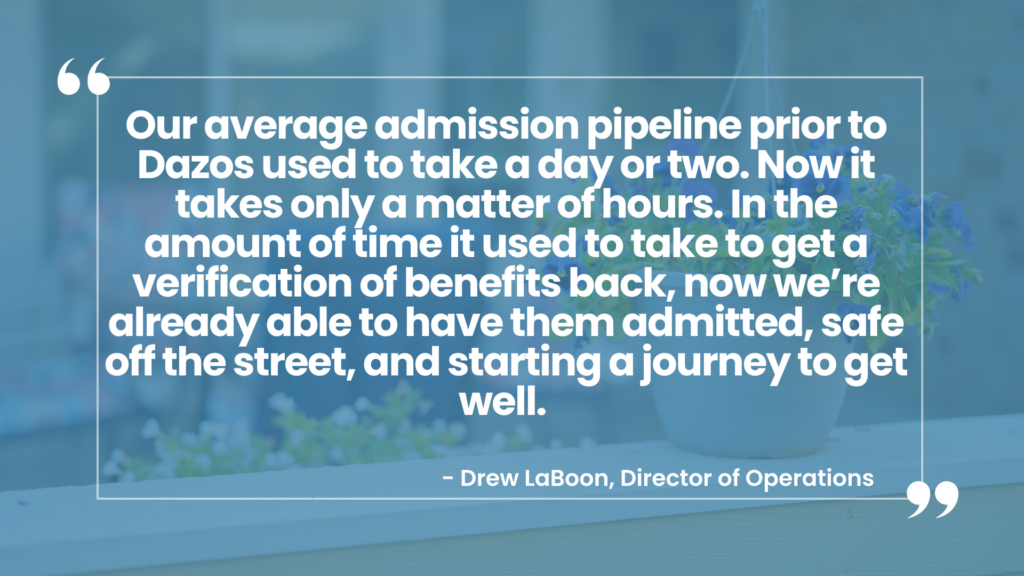
Drew LaBoon, Director of Operations at Pathways, found himself juggling a staggering four different platforms, leading to wasted time and information silos. Dazos offered a welcome solution: a user-friendly platform that could handle everything from capturing leads to verifying insurance benefits. No more third-party billers or manual data entry – Dazos promised a one-stop shop for all their needs.
The results were immediate. Verification of benefits, a process that used to take hours, now took a mere five seconds. Admissions that previously stretched over days were completed within hours.
A Dashboard that Empowers and a Feature Admissions Teams Adore
Pathways wasn't just impressed by Dazos' efficiency; they were also captivated by its customizability. The dashboard provided real-time insights into team activity and outcomes, allowing Drew to keep a pulse on the entire operation. The admissions team, in particular, raved about the seamless integration with their EMR system, a feature Drew highlighted as a game-changer.
Beyond Efficiency: Driving Down Readmission Rates
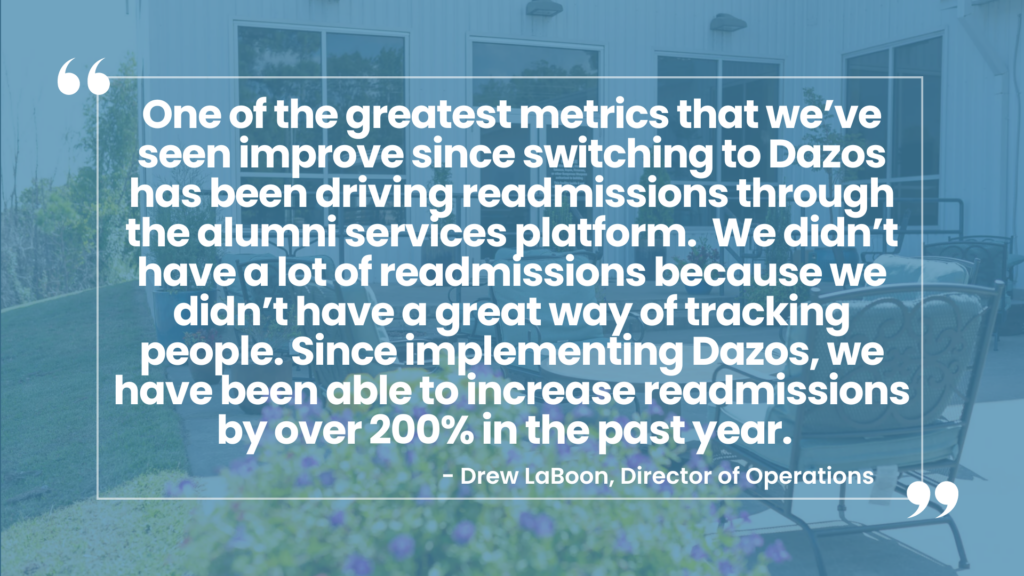
Pathways' success story extends beyond streamlined operations. Traditionally, tracking alumni and preventing relapses proved challenging. They relied on social media groups, a method Drew readily admitted as "ineffective." Dazos provided a powerful solution: a platform to stay connected with alumni and identify potential relapses early on. This proactive approach significantly reduced admission costs, which previously hovered around $3k-$5k per raw admission.
The Power of Early Intervention: Saving Costs and Saving Lives
Perhaps the most impactful outcome of implementing Dazos was the dramatic increase in readmission rates. By effectively engaging with alumni and identifying potential relapses early, Pathways was able to intervene. This not only saved the center significant costs but, more importantly, played a crucial role in the overall well-being of their patients.
Pathways Recovery Centers' story is a testament to the power of technology in revolutionizing addiction treatment. Dazos' HIPAA-compliant platform not only streamlined operations and boosted efficiency but also empowered Pathways to forge stronger connections with their alumni, ultimately leading to better patient outcomes. With Dazos by their side, Pathways Recovery Centers can confidently focus on their core mission: guiding individuals on the path to lasting recovery.
Atlas Healthcare Group, a leading behavioral healthcare provider in Los Angeles, California, faced challenges managing patient inquiries and admissions with their old CRM system. Their previous system lacked features crucial for behavioral healthcare and caused integration headaches with their EMR and Google Ads. This led to delays, hindering their ability to act quickly on inquiries – a critical factor in the behavioral health field.
Dazos to the Rescue
Atlas implemented Dazos CRM and Dazos IQ, a powerful data analysis tool, to streamline operations and unlock valuable insights, ultimately propelling their revenue and admissions. Dazos CRM offered a user-friendly interface with built-in features specifically designed for behavioral healthcare.This eliminated the need for extensive customization and ensured a smooth workflow.
How Dazos helped Atlas Healthcare Group:
- Streamlined Operations: Dazos' user-friendly interface and features made it easier for Atlas staff to manage patient interactions and admissions.
- Seamless Integrations: Dazos integrated effortlessly with Atlas's EMR and Google Ads, minimizing delays and ensuring data flowed smoothly between systems.
- Increased Efficiency: Faster response times to inquire due to Dazos' functionality led to a higher volume of admissions for Atlas.
The Results Speak for Themselves
Atlas Healthcare Group experienced significant benefits after implementing Dazos:
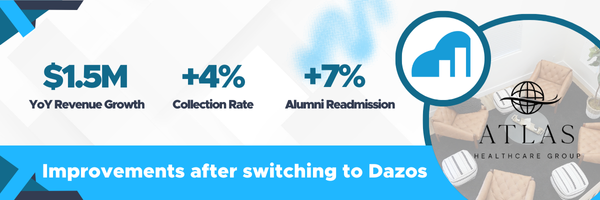
- Improved Revenue Collection: Dazos IQ's claim flagging feature, a data analysis tool, helped Atlas increase their collection rate by an impressive 3.5-4%.
- Enhanced Alumni Outreach: Dazos CRM's organization and notation capabilities facilitated a 7% increase in alumni readmission rates. This translates to significant revenue gains for Atlas, totaling $1.5 million since last year!
- Reduced Lag Time: Dazos' smooth integrations eliminated delays in communication, allowing Atlas to act swiftly on inquiries and admissions, crucial for potential patients seeking treatment.
The Dazos Difference
As Sam Epstein, COO of Atlas Healthcare Group, says, "Dazos is transformational for our industry. To have everything in one place, under one umbrella has been amazing. I’m happy with Dazos because it meets the needs of our organization, specifically because it was tailored for behavioral health.”
Ready to Transform Your Behavioral Healthcare Facility?
Contact Dazos today to see how we can help significantly increase admissions, revenue, and provide powerful insights into your business.

Quick Contact
Boca Raton, FL 33431